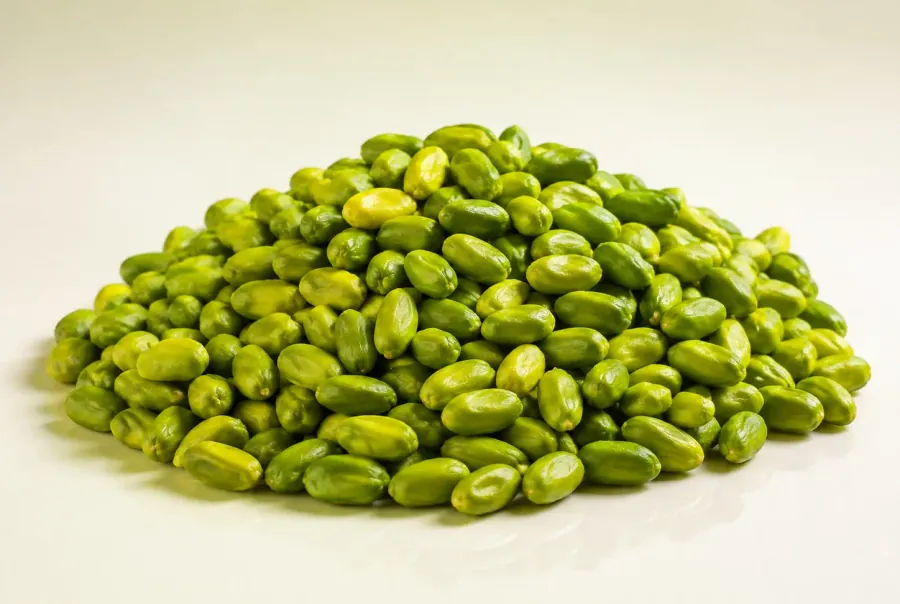
A written specification is what makes two pistachio quotations comparable. This checklist lists the points food manufacturers usually define for natural kernels, green peeled kernels (GPPK) and pistachio paste, and why each one matters.
Use it as a starting point for your own specification. It is not a supplier standard: the values and documents available for an order are agreed for each product and destination. For choosing between Iranian pistachio types and sizes, see the guide to Iranian pistachio types and sizes.
1. Product and cut
Form and cut
Why it matters. Whole, split, chopped, slivered, powder and paste behave differently on a production line and in the finished product.
Write in your specification. The form you need and, for pieces, the target size range or a reference sample.
Natural, early-harvest or peeled
Why it matters. Natural kernels keep their skin and mixed color; early-harvest kernels are greener; green peeled kernels (GPPK) have shell and skin removed for a uniform green.
Write in your specification. Which of the three you need, and whether skin-on early-harvest kernels are an acceptable alternative.
Source type
Why it matters. Kernel shape follows the nut type (round or long). It matters mainly when whole kernels are visible in the product.
Write in your specification. Only if your product shows whole kernels; otherwise leave it open.
2. Quality and food safety
Color
Why it matters. There is no single public grading standard for pistachio kernel color. Lots are described by each supplier's own grades, for example by the share of early-harvest green kernels, or by letter grades for GPPK.
Write in your specification. A photograph or sample of the color you accept, referenced in the specification rather than a grade name alone.
Moisture
Why it matters. Affects texture, shelf life and how the kernels behave in processing.
Write in your specification. The maximum moisture your process and storage can accept.
Defects and foreign material
Why it matters. Broken, discolored or damaged kernels and shell pieces affect yield and appearance.
Write in your specification. Your tolerances for each defect type, or your company's standard.
Aflatoxins
Why it matters. Limits are set by the importing market. In the EU, maximum levels for nuts are laid down in Regulation (EU) 2023/915; other markets have their own rules, and many buyers apply stricter customer standards.
Write in your specification. The regulation or customer standard you buy against, and the destination country.
Microbiology
Why it matters. Many buyers specify Salmonella absence and other microbiological criteria; some also require a pathogen-reduction step in the supply chain.
Write in your specification. Your microbiological criteria and whether a pathogen-reduction step is required.
Testing and documents
Why it matters. Customs and customers often need specific documents, and test results are only comparable if the method and laboratory are agreed.
Write in your specification. The analysis results you need reported for each lot, the type of laboratory you accept, and the documents your customs and customers require.
3. Paste
Composition
Why it matters. A 100% pistachio paste and a blended paste are different products with different uses and labels.
Write in your specification. 100% pistachio, or a blend, and any ingredients you accept or exclude (for example sugar, oil or milk).
Roast level
Why it matters. Roasting changes color and flavor; unroasted and lightly roasted pastes stay greener.
Write in your specification. Unroasted, light or darker roast, or a reference sample.
Kernel input
Why it matters. A greener kernel input generally gives a greener paste.
Write in your specification. Whether color is decisive, so the kernel input can be chosen for it.
Fineness and viscosity
Why it matters. Determines how the paste blends and flows in your process.
Write in your specification. How smooth and fluid it must be, ideally with a reference sample.
Cut and milled pistachio has more exposed surface than whole kernels, so packaging and storage matter more. Vacuum or nitrogen-flushed packs are common examples. State the pack type and size, the storage conditions in your warehouse and the shelf life you need on arrival.
5. Commercial context
Quantity, delivery window, destination and Incoterm, and whether this is a trial order or a recurring contract. These decide which lots and documents can be offered.
Copy-ready specification template
Copy the lines that matter to you into the quotation form or an email, and fill in your values.
Product: (natural kernels / early-harvest kernels / GPPK / paste)
Form and cut: (whole / split / chopped / slivered / powder; size range or sample)
Color: (reference photo or sample; grade name if you use one)
Source type: (only if whole kernels are visible: round / long / open)
Moisture: (maximum)
Defects and foreign material: (tolerances or your standard)
Food-safety standard: (regulation or customer standard; destination country)
Microbiology: (criteria; pathogen-reduction step yes / no)
Documents: (analysis results required per lot; other documents)
Paste only: (100% or blend; roast level; fineness)
Packaging and shelf life: (pack type and size; storage; shelf life on arrival)
Quantity and timing: (quantity; trial or recurring; delivery window; Incoterm)
Short answers to the questions procurement teams ask most when writing a specification.
01
Is there an international grade standard for pistachio kernel color?
Not a single public one. Suppliers use their own grades, often based on the share of early-harvest green kernels or letter grades for peeled kernels. Specify color with a reference photo or sample.
02
What aflatoxin limit should I write in my specification?
The limit that applies in your destination market or your customer's standard. In the EU the maximum levels are set in Regulation (EU) 2023/915. Name the rule you buy against so testing can be planned for it.
03
Do I need GPPK or are natural kernels enough?
Use green peeled kernels when a uniform bright green is visible in the product, such as premium chocolate or pastry decoration. Natural kernels are the usual choice when color uniformity is not decisive.
04
Does Rayan meet every point on this checklist?
This checklist explains what buyers usually specify; it is not a product specification. Which values and documents can be offered is agreed for each order and product.
Start a product conversation
Tell us what your production needs.
Share the product, grade, color, volume, packaging, and destination. Our export desk will respond with a clear next step.